Sunday, February 28, 2010


Wordle is in Trouble 2
It looks like Wordle is back up and running normally right now. Just read an article on Tech Crunch and I am so excited because Tech Crunch is taking notice of this little web app that teachers love. If Tech Crunch loves it maybe teachers will have more clout to get this thing resolved quickly! It looks like I will be able to use Wordle with my students tomorrow after all. Phewwwww!
Saturday, February 27, 2010
Wordle is in Trouble
Are you a trademark lawyer or intelectual property lawyer who believes in free web apps? If so please considering helping Wordle, one of the favorite apps of my students. The Wordle Site is now shut down and the founder and creator of Wordle, Jonathan Feinberg is asking for some pro bono legal help! I was planning on using Wordle with my students on Monday, so if you can help please contact him!
FIZZ Workshop from #PETE&C
Got to attend 3 sessions during Sunday’s Discovery Education Network (DEN) Day at Pennsylvania’s Educational Technology Expo and Conference (PETE&C).
My first session was called FIZZ (which I was given as my first choice because I presented a recess session... a preliminary unveiling of the PicturingAmericaMIAC Wiki that I, the other district librarians, and ELL teacher Kathy Wahl created to highlight the usage of the Picturing American Illustrations awarded to our district libraries through a grant from the American Library Association and the National Endowment For the Humanities. We paired each illustration with DEN Videos that can be used to give students more of a background of the events depicted in the illustrations).
I am not really sure why I chose to attend a session called FIZZ taught by a man named Lodge but my online friend and DEN Guru Stacey Kasse recommended the session and I was not disappointed.
Dr. Lodge McCammon is from the University of North Carolina’s Friday Institute. He shared ideas for using user-generated videos in the classroom (or in my case the library). He started by giving us a formative assessment modeling the use of a Google Form. The free resource is worth checking into for district use. The assessment checked our knowledge of math concepts such as area, surface, and volume.
The first idea he gave was to create an introduction video for the lesson, a teaching tool. He suggested going somewhere other than the classroom or library with a video camera to create a real-world use for the concept you are trying to teach. My idea that I took away would be to go to Lower Providence Library and show students that if they learn how to use the Arrowhead Library they can use the Dewey Decimal System in any library. Creating real-world context and interest is in line with library standards. The idea is to post the video online so students can always come back to it. This will help differentiate instruction as some students may need to watch the video over and over for repetition of the concept.
Next, we were given paper slides, a Flip Video Camera, and a script that went along with the paper slides. We were directed to work in pairs to create a video lesson. The theme of the day from Dr. Lodge, was that the end product did not have to be perfect because the focus is on the content. We only had 15 minutes to create the video in one take, no editing was allowed. This is a great project to use with younger students, I am going to try it with 3rd graders in the library as soon as we finish researching our topics. We never did get to see the results, hope Dr. Lodge puts them on his blog sometime soon.
Dr. Lodge is great at creating songs with lyrics that teach the lesson he is trying to convey. Please check out his blog post from the day’s work, and look for The Base-Morning White video, you will see how my group interpreted the song. Which taught a lesson. Dr. Lodge kept the song playing the entire time we were working in our groups. He also gave us a paper with the song lyrics. Looking at the lyrics while listening to the song gave a different dynamic to the lesson and may be the spark some students need to understand the concepts. I think I would like to see what happens if students are expected to come up with their own lyrics- they could even use their favorite songs, it worked for Weird Al Yankovick but in this case a lesson would be taught. I was thinking of having 4th or 5th grade students create a song about library skills and then use the video they create with 2nd and 3rd grade students. We could also post the video on the district website so students could go back and view it over and over, talk about reinforcing a lesson!
We were split into groups and were assigned a verse of the song. My Morning White group was assigned the Chorus. We had time to prepare our choreography for the chorus, using whatever props we had on hand which was not much. We practiced once as a whole group and then recorded the final product. The results are posted on Lodge’s blog: http://www.iamlodge.com/ryosin/?p=76.
At the end Lodge showed a summary video he created to reinforce the lesson. It seemed like a traditional lesson just video taped and posted online for students to view later. It is good reinforcement and students can watch the video over and over if they need the practice. The day ended with a summative assessment again using a Google Form. The results indicated that everyone in the room had learned quite a bit about math while working with the concepts through video production, not a traditional way to learn math concepts.
Wednesday, February 10, 2010
How to recognize secure websites...
Lee Lefever has done it again. He and his Common Craft website are wonderful for teaching us how to do things on the Internet. His newest is called "Secure Websites in Plain English." It's great! Everythng you need to know before shopping online! You can follow Lee Lefever on Twitter too.
Saturday, January 23, 2010
Wiffiti for EduCon 2.2
Until today I had never heard of a Wiffiti. Now I am embedding the Educon 2.2 one here:
I am so excited to be going to EduCon 2.2 next weekend. I am so excited to be meeting some of the people in my Personal Learning Network (PLN). These are people that I know virtually but have not met in real life, yet I learn more from them than I do in all the professional development classes I take! Now a wiffiti... see what my PLN has to say if you can keep up, it moves a little fast for my old eyes!
I am so excited to be going to EduCon 2.2 next weekend. I am so excited to be meeting some of the people in my Personal Learning Network (PLN). These are people that I know virtually but have not met in real life, yet I learn more from them than I do in all the professional development classes I take! Now a wiffiti... see what my PLN has to say if you can keep up, it moves a little fast for my old eyes!
Sunday, January 10, 2010
iPhone wins touch screen quality test

I am very hooked on my iPhone. I would not give it up for anything and now it looks like I won’t have to because iPhone won the touch screen quality test. The link above and photo to the left will lead to the article by the Electronista Staff about how great the iPhone responds to the lightest touch.
The only way Apple can do better is if they introduce their much anticipated tablet PC later this month. The computer is rumored to be called the iSlate. It is supposed to be 10 inches. A slate computer in my opinion would change the face of education. It would make e-books more accessable to students and change libraries forever.
I for one hope all the rumors are true. Can't wait for Apple's announcement that is supposed to happen later this month but it is unclear if it will be January 26th or 27th. I have heard rumors about both dates. January will be a big month for announcements, the Newbery, Caledcott, and Dr. Seuss awards will be announced at the ALA Mid-Winter Meeting, January 15-18 in Boston. Enjoy your January announcements. I know I will.
Wednesday, January 06, 2010
Protecting Reputations Online
In light of the newest situation where a Bangor, Pennsylvania teacher's aide had a nude photo of herself passed around her school, it is becoming more and more important to protect your reputation online. Young people do not have any problems posting pictures of themselves and their friends online in less than flattering situations and sometimes compromising positions. While it may seem harmless now what are those pictures going to do to future reputations? I once heard New York Times columnist David Pogue say never to post anything that you would not want your grandmother to see and that things posted online never stay where you put them (people "borrow" stuff and re-post to other sites). There is a new Commoncraft Show Video called "Protecting Reputations Online in Plain English" It is aimed at young people to try to get them to be more careful about what they post. The video is for evaluation only but as usual, Lee Lefever gets it right.
Monday, November 30, 2009
Yeah! Staff Sargent Corey Nawrocki is Home!
For the past year my teacher prayer group has been praying for the friend of one of our teacher's daughters. Don't blame me for being a little bit happy that Marine Corps Staff Sergeant Corey Nawrocki has returned home from Afghanistan. This was his sixth tour overseas in the battle spray. And rightly Fox Philly did a story on his homecoming.
Next stop for Staff Sergeant Corey Nawrocki, the White House! His next tour of duty is the Presidential Detail in Washington, DC. Yeah, his mom is so proud!
Next stop for Staff Sergeant Corey Nawrocki, the White House! His next tour of duty is the Presidential Detail in Washington, DC. Yeah, his mom is so proud!
Sunday, November 15, 2009
Magic
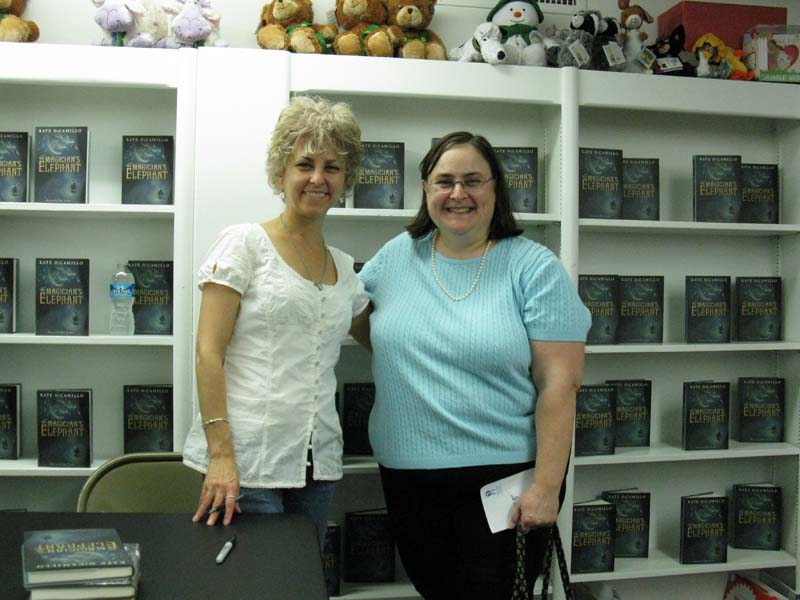
Powerlibrarian has always been about moving elementary readers to the next level. Something happened to me on Friday night that I won’t long forget. I met author Kate DiCamillo. The picture on the left is of Kate and myself. I dragged my daughter away from her husband and my 15 month old grandson on a Friday night to go and meet Kate at a book signing for her new book, “The Magician’s Elephant” at Children’s Book World on Haverford Station Road in Haverford, PA. It turns out that Children’s Book World is less than 6 miles from where Kate was born at Lakenau Hospital, which is in the neighborhood where I grew up and is where my brother was born too.
My daughter was speaking to some of the other moms who had shoved their kids to the front of the line, she was saying, “yes, she is 12.” And I realized she was talking about me. And she was right. I was 12 because there was magic at Children’s Book World that night and it transformed me into a 12 year old. The magic was books, Kate DiCamillo’s books. When Kate read from the first chapter of “The Magician’s Elephant” something happened. Something more than the hush that fell over the room. It was as if the elephant were really there in the room, or it soon would be tumbling out of the ceiling like the elephant in the book. When I took my first library class some 8 or 10 years ago I thought elementary libraries were going out of style. I wanted to make sure that technology played a big role in whatever Library Skills I was teaching kids. Well, listening to Kate DiCamillo reading from the first chapter of her new book “The Magician’s Elephant” made me realize that elementary libraries are not all about technology; they are all about magic. And the magic is different for each student. The trick is to discover where the magic spark lies in each student and make it happen for him or her in the short 40 minutes I see them each week. I have decided this week to let Kate’s words stand for themselves. I am showing two short videos I took of Kate reading from her book “The Magician’s Elephant” to my students this week. For me her reading was magic. Meeting Kate on Friday night was magic, I want my students to feel that excitement. I want to share my enthusiasm about Kate’s books. Let's hear it for the magic in children’s books, especially Kate DiCamillo’s books. The magic that can transform a children’s world in ways that no other reading in their later life can!
Saturday, November 14, 2009
Kate DiCamillo reads from "The Magician's Elephant"
I had a blast tonight (actually last night now that I look at the clock) at Children's Book World in Haverford, PA. Kate DiCamillo is one of my favorite authors and after 10 years of loving her books and insisting that children read her books I finally got to meet her and hear her read from her new book, "The Magician's Elephant" from Candlewick Press.
More pictures to follow.
More pictures to follow.
Saturday, October 03, 2009
The genius of Apple

Why come out with an iPod nano with video? Sounds like such a trivial addition to the product but with that single move Apple could be re-positioning itself in the world of education in a monumental way. I didn’t think of it at first, I thought was “what a waste of an announcement, that it was just a ploy to get Steve Jobs out there in front of people again.” But then I started talking to teachers, librarians, and instructional technology integrators in my school district and I began to see a totally different picture of the iPod nano. First, teachers have long seen the benefits of video in the classroom and on field trips. Traditionally that meant lugging the district or school video camera and let’s face it, even the little school video cameras are big. If your district is more forward thinking you may have one of the new smaller video cameras such as a Flip Video, the RCA Small Wonder or similar small video cameras. However, my district will not allow such video devices because of the proprietary software they require. The videos will not download properly without the software embedded in the camera, which our district blocks teachers from downloading and renders the device useless. Now enter the librarians (and music teachers) who already have convinced the tech gods to allow them to have iTunes. The precedent has been set, iTunes is allowed on district computers for music teachers to download songs and for librarians to borrow and download public library audio books. The interface used by the iPod nano is iTunes. Problem solved. And, will librarians have a use for video? As Sarah Palin has said more than once, “you bettcha”! The library catalogs in our district allow for students to create their own video and audio reviews of books and embed them right into the record of the book so others can see and hear it when they search the catalog. What a great way for students to leave their mark on their school by recommending books to their friends. What a great way to get other kids to read, with recommendations from their peers. Can you tell I am excited? Lastly, instructional technology integrators in our districts are very down in the mouth these days since there is little money in the technology budget. Think of the cost savings this little iPod nano with video will give school districts. They will need to buy only one device instead of the two they traditionally buy. One device that is similar in price to either of the other two devices they now buy… a two for one deal sounds good in my mind. One device that now does the work of two, brilliant. Apple had their thinking caps on for this one folks, it just may be a way for them to break back into the education market which at least in the case of my district has gone to the PC side exclusively. What about your district? PC or Apple? Can you see uses for this new iPod nano? Please comment below. I am looking forward to your thoughts and the dialogue.
Saturday, September 26, 2009
21st Century Learning
I think maybe these guys got it right. We need to start thinking outside the box in education.
Love the idea of teaching with Primary Sources but Primary Sources are not just Library of Congress archives. A bus ticket or subway token can be a primary source. Show and tell is an example of teaching with a primary source, and helps students use 21St Century Skills when planning their presentations. As educators we must get on the rocket that is 21st Century Learning or we will get left behind. And if we are left behind so are our students and that can't happen!
Love the idea of teaching with Primary Sources but Primary Sources are not just Library of Congress archives. A bus ticket or subway token can be a primary source. Show and tell is an example of teaching with a primary source, and helps students use 21St Century Skills when planning their presentations. As educators we must get on the rocket that is 21st Century Learning or we will get left behind. And if we are left behind so are our students and that can't happen!
Sunday, September 13, 2009
Build a Squid

 Not sure what the point of this is, besides fun, but I just built my own squid and played with it for a while until it went off to find new adventures. I think it could be educational if students were doing research on what can happen to squid. My squid swam through a cloud of plankton already and it's not even an hour old. Now Squiky, my squid, had a fight with a leopard seal. Poor guy. It is a pretty cool interactive game for those science minded elementary teachers. Check it out, it is from the Government of New Zealand. It is called Build a Squid. Again, my squid's name is Squiky. You can visit him by searching on his name. If you look at the picture on the right, it looks like Squiky is waveing to you! I did the screen captures using Jing and then edited the pictures in PhotoShop.
Subscribe to:
Posts (Atom)